Arriving in Thailand · Guide
Bangkok Transport Decision Guide: BTS/MRT vs Grab vs Metered Taxi (2026)
Bangkok does not have a transport problem — it has a decision problem. The trains are fast, the roads are slow, the taxi meter starts at 35 baht, and the fare systems do not talk to each other: the card that taps you into the MRT will not tap you into the BTS, and the stored-value card that works on the monorail dies at the MRT gates. Most visitor frustration with Bangkok transport is really a payment failure or a peak-hour mistake, not a missing train. This guide is built around one decision rule — rail first when the roads are jammed, taxi or Grab when they are not — and one payment matrix that shows exactly what each system will and will not accept.
Published Updated
Entry rules and prices change. This guide shows its last check date in the fact-check box below — re-check the visa section before you fly.
Fact check
- Checked on
Sources
- BTS SkyTrain official site — fares, Rabbit card and day pass terms (read November 2026)
- MRTA — MRT blue/purple fares effective 3 July 2026
- Bangkok Expressway and Metro (BEM) — MRT blue line operator
Dates and sources below come from the article data file. Where official pages do not publish a figure, the article says so instead of picking one number.
The payment matrix: what each system takes
| Mode | Fare | How you pay | The trap foreign travellers hit |
|---|---|---|---|
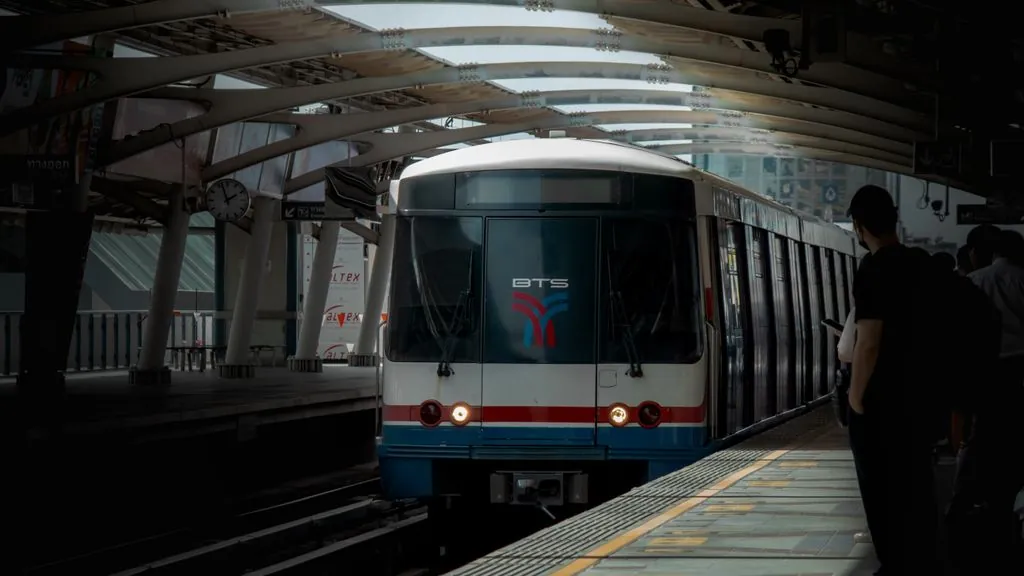
| BTS SkyTrain (Sukhumvit & Silom green lines) | 17–65 baht | Single-journey ticket or Rabbit card only — the gates do not take bank cards | Assuming your contactless card works at the gate. It does not. Your first BTS ride means buying a ticket or a Rabbit card. |
| MRT blue & purple lines | Blue 17–44 / purple 14–42 baht (prices effective 3 July 2026) | Tap an EMV contactless credit card straight at the gate (Visa, Mastercard, UnionPay all work), or a single-journey token | Foreign debit cards often fail to tap. And you must use the same card in and out — a different one bills you the maximum fare. |
| Monorail yellow & pink lines | 15–45 baht | Single-journey ticket or Rabbit card | These serve the suburbs, where visitors rarely go. A Rabbit card works here but dies at the MRT gates — the cards do not interchange. |
| Airport Rail Link | 15–45 baht | EMV contactless card or single-journey ticket | This row is deliberately short: the full airport-to-city decision gets its own comparison page (linked at the end). |
| Metered taxi | Meter starts at 35 baht | Cash | A price 'agreed' before the ride is a different deal from the meter. The 35-baht flag fall is the official starting fare — the meter should run. |
| Grab / Bolt | Locked in the app when you book | In the app | Surge pricing at peak times: the locked price for the same ride can jump well above the metered fare. |
| Tuk-tuk | No meter — agree the price before you get in | Cash | It is a priced experience, not transport with a fare schedule. Negotiate first, always. |
One system-level fact worth internalising before any of the detail: Bangkok's rail payment systems are three separate worlds. The BTS takes its own tickets and the Rabbit card. The MRT blue and purple lines, and the Airport Rail Link, take an EMV contactless credit card directly at the gate. The monorails take Rabbit. No card works everywhere, and the MRT's old stored-value cards were discontinued on 1 June 2026 — if an older guide tells you to buy one, that advice has expired.
The decision axis: Bangkok's peak hours
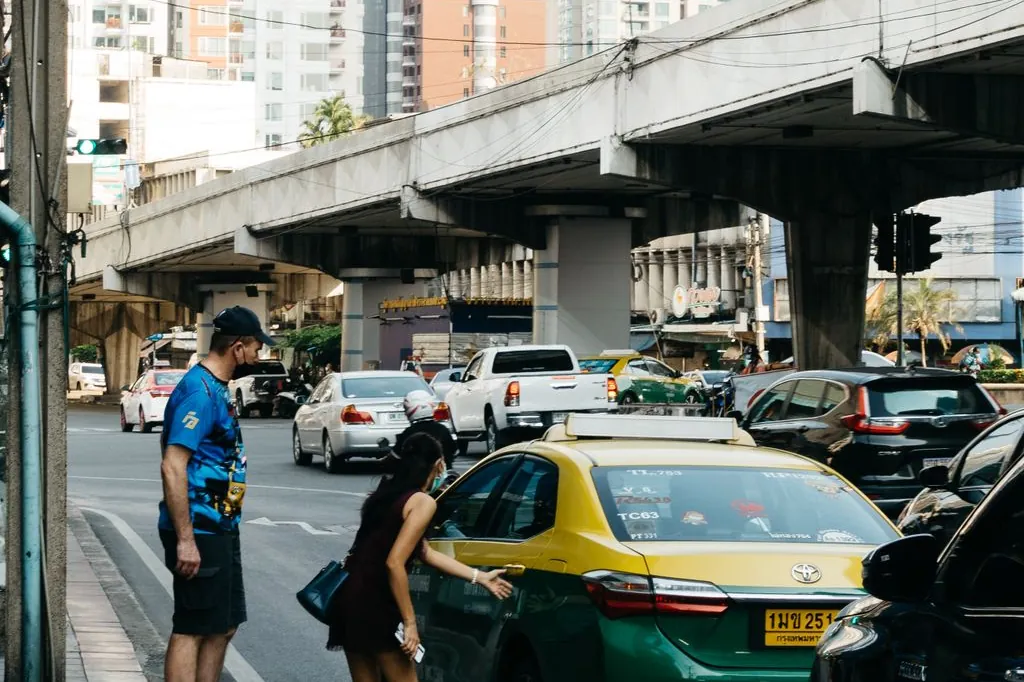
Everything in this guide hangs on one fact pattern. On weekdays, the roughly 07:30–09:30 and 16:30–19:30 windows jam Bangkok's roads hard — in the central areas, surface traffic speeds can drop below 20 km/h. At those times, the elevated and underground trains are the only things in the city moving at a predictable speed, so the peak-hour decision is made for you: take the rail.
Outside those windows, the calculus flips. Bangkok's traffic is not uniformly bad — it is concentrated — and a metered taxi or a Grab in a quiet midday or late-evening window can be faster door to door than walking to a station, riding, and walking again. The exceptions are the corridors rail serves directly, which the next section maps.
By scenario: the default choice
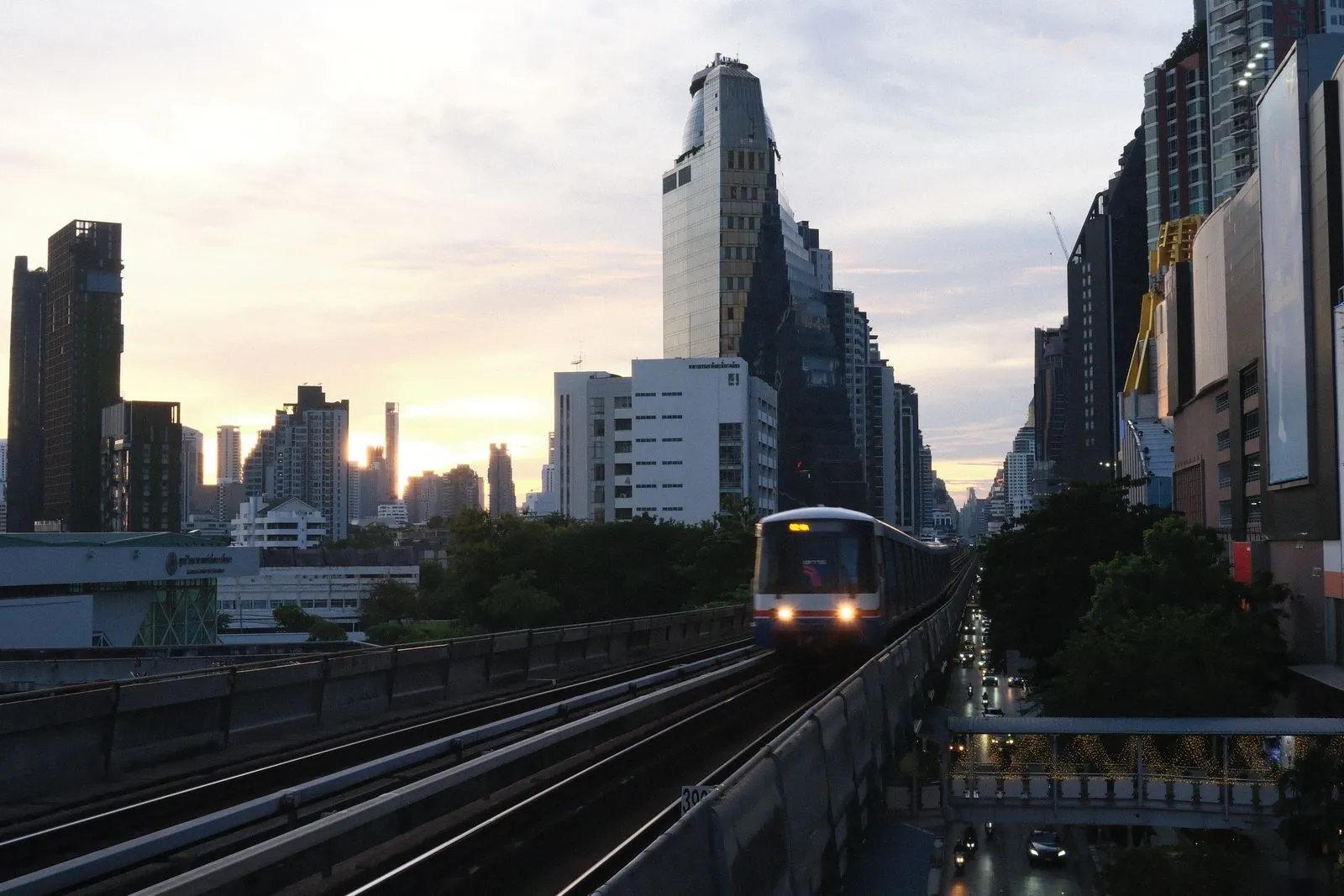
Weekday peak hours (roughly 07:30–09:30 and 16:30–19:30): rail, unconditionally. Central road speeds can fall below 20 km/h while the trains keep their schedule; a taxi or Grab booking during surge pricing can also cost more than the same trip by train. If your movement falls inside these windows, do not debate it — get to a station.
The old town and the river (Grand Palace, Wat Pho, Wat Arun): the MRT blue line, to Sanam Chai station. It puts you closer to the old town's sights than any other rail stop, and the blue line taps in with a contactless credit card, which makes it the friction-free choice on a card that BTS cannot match.
The Sukhumvit corridor (the long strip of hotels, malls and nightlife along Sukhumvit Road): the BTS green line, which runs the corridor's length. Sukhumvit is BTS territory — the line stops at Asok, Thong Lo, On Nut and the rest of the addresses travellers actually book. The MRT does not serve this corridor.
Late night: check the trains first, then fall back to a taxi or Grab. The BTS runs roughly 05:30–24:00, with first and last trains varying by station, so a late evening out needs the actual last-train time for your station — and a taxi or Grab plan for after it.
Bulky luggage: taxi or Grab, door to door. Rail wins on speed inside its network, but it does not carry you from your hotel's doorstep, and airport-to-city luggage decisions have their own comparison page anyway.
The Rabbit card: what it actually costs in 2026
The Rabbit card is the BTS's stored-value card, and the price of getting one changed in late 2026 — which is why so many older guides are now wrong about it. Current terms from BTS: the card itself costs 120 baht with no deposit, and your first top-up must be at least 100 baht. That means the counter takes 220 baht from you in total. The 200-baht figure still circulating in older guides (100 issuance + 100 credit) is outdated — do not budget by it.
Buying a Rabbit is a named-card purchase: show your passport at the counter. After that, top-ups run from 100 baht up to a maximum stored value of 4,000 baht.
- Works on: the BTS green lines, the gold line, the pink and yellow monorails, and the BRT buses.
- Does not work on: the MRT blue and purple lines, the Airport Rail Link, or the SRT red lines.
- Worth it when: you will ride the BTS on several days and want to skip the ticket queue each time.
- Not worth it when: your Bangkok legs are mostly MRT or airport trips — an EMV credit card already covers those gates with zero setup.
One alternative to weigh against it: the BTS one-day pass costs 150 baht and gives unlimited rides — but only within the two green BTS lines. If your day is a Sukhumvit-and-Silom day, it can beat both the Rabbit card's setup cost and per-ride fares; if your day reaches the MRT or the river, it covers nothing there.
The 20-baht flat fare: not for you
If you read about a 20-baht flat fare on Bangkok's rail lines somewhere: that scheme applies only to Thai citizens who register with a Thai ID card in the Tang Rat app — as a foreign visitor you pay full fares on everything, and this guide does not need to enter that policy beyond this sentence.
Coming from the airport?
The Airport Rail Link's fares are in the matrix above, but the real decision — rail into the city versus a fixed-price car versus a metered taxi from the rank, with late-night and scam-trap notes — is a comparison of its own. It lives in our airport-to-city transfer comparison, linked below, and we keep the prices in exactly one place so they cannot drift out of sync between pages.
Where the numbers come from — and the two we had to pick
| Number | What we print | Why |
|---|---|---|
| BTS top fare | 17–65 baht, uniformly | The core network is 17–47 baht; the longest trips that cross onto the extension sections reach up to 65 baht. Secondary sources put the maximum anywhere from 59 to 65, so the table prints the single range 17–65 rather than pretending to one exact top figure. |
| Rabbit card total | 220 baht at the counter | BTS's own terms as of November 2026: 120 issuance + no deposit + minimum 100 first top-up. Older guides' 200-baht total predates the change and is wrong today. |
| MRT fares | Blue 17–44 / purple 14–42 baht | The MRTA/BEM price list effective 3 July 2026, the currently operative one. |
| Foreign debit cards on MRT | "often fail" | We print the warning directionally because that is what the operator guarantees (credit cards) and what travellers repeatedly report (debit failures) — we do not print a failure rate, because none is published. |
| Train frequencies and crowding | Not printed | No official published figures exist; this guide stays qualitative where the sources are. |
About this guide
This guide is general travel information, checked against operator-published fares and terms on 12 November 2026 — it is not affiliated with or endorsed by BTS, MRTA, BEM or any transport operator. Fares, payment rules and hours change; the operators' current publications always govern. Re-check the sources listed below before you rely on a number.
Keep planning
Four pages from this site that pair with a Bangkok transport plan:
Bangkok airport to city, compared
Airport Rail Link vs metered taxi vs Grab vs fixed-price cars — fares, hours, door-to-door times and the late-arrival traps, in one table.
Compare airport transfersBudget calculator
Drop your Bangkok transport spending into the daily budget and see what the whole trip costs.
Open the calculatorTaxi dialogue practice
The Thai phrases that make a metered-taxi ride go right — practice the conversation before you hail one.
Practice the dialogueThe arrival checklist
TDAC, the SIM, the first baht of cash and your first ride — everything to sort in your first 72 hours.
Read the checklistAffiliate link
This is an affiliate link: we may earn a commission if you buy through it, at no extra cost to you. It does not change what we recommend.
Say it in Thai
Learn the phrases from this guide, then practise them in a full dialogue.
Practise dialogues
Phrase pages